
What is a microturbine?
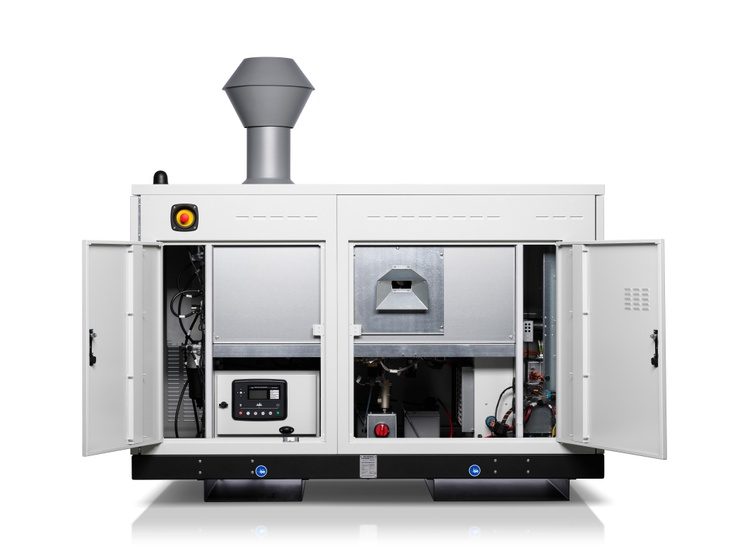
A microturbine is a small gas turbine, typically rated from 1 kW to 500 kW, that generates electricity by burning fuel to spin a turbine wheel coupled to a high-speed generator. The compressor, turbine and generator rotor sit on a single shaft, so the whole engine has one rotating assembly. Bladon builds at the lower end of that band: the MTG12 at 12 kVA / 12 kW and the MTP40 at 40 kVA / 32 kW prime, 44 kVA standby.
How a microturbine works
A microturbine runs a recuperated Brayton cycle: compress air, heat it, expand it through a turbine, and recover what is left in the exhaust. The sequence below follows the air and gas path in order, from the intake filter to the terminals.
- 1
Air intake and compression
Ambient air is drawn in through a filter and enters a centrifugal compressor mounted on the main shaft. The compressor raises the air pressure and, as a consequence of that compression, its temperature. Everything downstream depends on getting a steady, clean, pressurised air supply at this stage, which is why air filtration is the main consumable on a microturbine at a dusty site.
- 2
Recuperator
The compressed air passes through a recuperator before it reaches the combustor. A recuperator is a heat exchanger that puts the hot exhaust leaving the turbine into thermal contact with the compressed air leaving the compressor, which is already hot from compression and still much cooler than the exhaust. Heat crosses from one stream to the other, so the air arriving at the combustor is already hot and less fuel is needed to reach firing temperature. That single component is the difference between a small turbine with poor electrical efficiency and one that is worth running as a prime power source. An unrecuperated microturbine of this size would waste most of its fuel energy out of the exhaust.
- 3
Combustion
Fuel is injected into the preheated air in a continuous-flow combustor and burns steadily. Combustion is continuous, with none of the intermittent explosions of a piston engine, at lower peak pressure and with more complete burn. That is the reason for the low particulate figures, and it is also why the combustor can accept a wide span of liquid fuels with no change to the rest of the machine.
- 4
Turbine expansion
The hot, high-pressure gas expands through the turbine wheel and spins it. Part of the work done by that expansion drives the compressor on the same shaft; the remainder is the useful output of the engine. Exhaust gas leaving the turbine remains hot, and it is routed back through the recuperator before it goes to atmosphere.
- 5
High-speed generator
The generator rotor sits on the same shaft as the compressor and turbine, so there is no gearbox and no belt drive. The shaft turns at very high speed: the MTP40 operates across 50,000 to 120,000 RPM and the MTG12 across 65,000 to 135,000 RPM. Spinning the generator directly at turbine speed is what allows a machine this small to produce useful electrical power.
- 6
Power electronics
A generator turning at those speeds produces AC at a high frequency that varies with shaft speed, which no ordinary load can use. Power electronics rectify that output to DC and then invert it back to clean AC at 50 Hz or 60 Hz. This stage decouples shaft speed from output frequency, which is why the engine can change speed to follow load while the voltage and frequency at the terminals stay stable.
All of that happens on one rotating assembly. The compressor, the turbine wheel and the generator rotor sit on a single shaft, supported on air bearings, with no gearbox and no second shaft anywhere in the engine.
The single moving part
The defining architectural feature of a microturbine is that one assembly rotates. Compressor, turbine wheel and generator rotor share a common shaft, turning together in one direction at one speed. There is no gearbox, no belt and no reciprocating motion anywhere in the engine.
A reciprocating engine of the same output contains pistons, piston rings, connecting rods, a crankshaft, valves, valve springs, a camshaft and timing drive, an oil pump and oil filter, a water pump, thermostat and radiator. Each of those is a wear item with its own service schedule and its own failure mode, and most of them are only present to manage the consequences of reciprocating motion.
The maintenance consequence follows directly from the part count. Bladon quotes one service visit per year against a design life of 45,000 hours. At a site where an engineer visit means a long drive, a boat or a helicopter, the number of scheduled visits is often the largest single line in the operating budget.
Air bearings, and why they matter
The shaft in a Bladon microturbine runs on air bearings. Rotation drags air into a converging gap between the shaft and the bearing surface, and the pressure generated in that film lifts the shaft clear. Once the machine is at speed the shaft is supported by air, with no oil-lubricated journal and no rolling elements.
The consequences are practical. There is no lubricating oil in the engine, so no oil changes, no oil to degrade at temperature and no oil to leak or dispose of. There is no bearing wear at speed, because nothing touches. There is no liquid coolant circuit on the MTG12, which is air cooled. Dust and heat shorten oil life and force shorter oil-change intervals at desert and roadside sites. Neither applies here, because there is no oil.
Air bearings are a demanding technology and it is worth being clear about where the difficulty lies. At start and shutdown the shaft is below the speed needed to build the air film, so it is briefly in contact with the bearing surface. Surviving that contact for thousands of cycles is a matter of coating chemistry and of bearing geometry held to fine tolerance. It is the reason air bearing turbines took decades to reach the field, and it is solved: Bladon's units are running on them today.
Shaft speed is high and it varies with load. The MTP40 operates across 50,000 to 120,000 RPM, and the MTG12 across 65,000 to 135,000 RPM. There is no single flat running speed, because the power electronics decouple shaft speed from output frequency.
Microturbine vs reciprocating engine vs fuel cell vs solar hybrid
Reciprocating engine
The diesel or gas genset is the default answer and it is cheap to buy. It gives good full-load efficiency and universal parts availability. The cost lands later: oil and filter changes on a short interval, poor efficiency and fouling at low load, high particulate emissions, and a fuel that has resale value on the black market in many regions.
Fuel cell
Fuel cells offer high electrical efficiency and near-silent operation with no combustion. The constraints are fuel supply, capital cost and stack life. Hydrogen logistics do not exist at most remote sites, methanol and reformer variants add complexity, and stack replacement is a scheduled capital event.
Solar and battery hybrid
Solar with storage carries the lowest running cost when the resource is good and the land is available. It needs a firming generator for the days it cannot cover, which in practice is usually a diesel, and that generator determines the site service schedule. Replacing the firming diesel with a microturbine is where hybrid sites see their maintenance cost fall.
Microturbine
Higher capital cost per unit than a diesel of the same rating, with one rotating assembly, one service visit a year, several usable fuels and low particulate output. It suits sites where a visit is expensive, where fuel goes missing, or where emissions and noise limits apply.
What microturbines are used for
- Off-grid and bad-grid telecom towers
Tower sites with no grid, or a grid that fails daily, need firm power at a cost that scales across thousands of locations. Service visits, not fuel alone, dominate the bill.
- Defence forward operating bases
Deployed power where the logistics chain is the constraint. Fewer service visits and multiple usable fuels reduce the number of movements a site depends on.
- Oil and gas remote monitoring
Wellhead instrumentation, cathodic protection and pipeline telemetry at sites hours from the nearest depot, often in high ambient temperatures and heavy dust.
- Critical infrastructure backup
Emergency services masts, water treatment, rural broadband exchanges and other loads where an outage has consequences beyond the site itself.
- EV charging support
Charging points ahead of a grid reinforcement, where a quiet, low-particulate generator can be sited close to people and vehicles.

Fuel flexibility
Continuous combustion at moderate peak pressure is tolerant of what it burns, so a microturbine accepts a wider span of fuels than a compression-ignition engine. Two lists matter here and they must be kept apart: what runs today, and what is in development.
Running today
- Diesel
- Kerosene
- Paraffin
- HVO
- FAME biofuel
- Blends of these in any ratio
In development
- Biogas
- LPG
- Natural gas
- Flare gas
- Hydrogen
- Ethanol
- Bioethanol
These fuels are development programme targets. They are not available to order.
Are microturbines expensive?
Capital cost per unit is higher than a comparable diesel genset. That is a real difference and it does not disappear over the life of the machine; it is recovered, or it is not, through what the site spends after commissioning.
Three conditions decide the answer. Sites with a high cost per service visit, whether from distance, access or security escort, benefit from moving to one service visit per year. Sites with fuel theft exposure benefit from running kerosene or paraffin, which have little black-market value. Sites under emissions or noise limits benefit from the particulate and noise figures. Where none of those apply, for example low run-hour standby behind a reliable grid, a diesel usually remains the cheaper answer.
The honest way to settle it is to model your own site: your fuel price, your visit cost, your run hours and your theft rate.
Frequently asked questions
What is a microturbine generator?
A microturbine generator is a small gas turbine engine coupled directly to a high-speed electrical generator, packaged with the power electronics needed to deliver usable mains-frequency output. Typical ratings run from about 1 kW to 500 kW. It performs the same job as a diesel generator set, using a continuous-combustion turbine in place of a reciprocating engine.
How does a microturbine differ from a gas turbine?
A microturbine is a gas turbine, scaled down and simplified. Large industrial turbines use multiple compressor and turbine stages, oil-lubricated bearings, gearboxes and complex auxiliary systems. A microturbine typically uses a single-stage compressor and turbine on one shaft, adds a recuperator to recover exhaust heat, and drives the generator directly at shaft speed.
How efficient is a microturbine?
Recuperated microturbines in this power class typically deliver electrical efficiency in the mid twenties to low thirties as a percentage, which is what the recuperator makes possible. The figure that matters at a real site is efficiency across the load profile: a microturbine is more efficient at part load than a diesel genset, which loses efficiency and fouls when it runs lightly loaded. Combined heat and power raises the total useful energy per litre further where the exhaust heat can be used on site.
What is an air bearing and why does a microturbine use one?
An air bearing supports the rotating shaft on a thin film of pressurised air produced by the shaft's own rotation, in place of an oil-lubricated journal or a rolling element bearing. Once the shaft is up to speed there is no metal-to-metal contact and no lubricating oil in the machine. That removes oil changes, oil degradation and oil leaks from the maintenance schedule, which is a large part of why the service interval is what it is.
How long does a microturbine last?
Bladon quotes a design life of 45,000 hours, with one service visit per year. Life expectancy in this class of machine comes from the low part count and the absence of the wear mechanisms that limit a piston engine: no piston rings, no valve train, no oil to contaminate. Achieved life at a given site still depends on fuel quality, air filtration and ambient conditions.
How loud is a microturbine?
On noise, MTG12: 60 dB LPA at 10 m (50 dB LPA at 10 m with the optional Silent Pack). MTP40: 60 dB(A) at 7 m and 85 dB(A) at 1 m (design target, not yet verified by test). Measured at 10 m in free-field conditions, per the product datasheet. The character of the sound differs from a diesel: a turbine produces a steady higher-frequency note with none of the low-frequency knock of a reciprocating engine, which is usually the component that carries furthest and draws complaints on residential and noise-restricted sites.
Can a microturbine run on hydrogen?
Not today. Hydrogen is on the Bladon development programme and is not an available fuel. The fuels running today are diesel, kerosene, paraffin, HVO and FAME biofuel, in any blend. Continuous combustion suits hydrogen better than a spark-ignition or compression-ignition engine does, and the combustor is a modular sub-assembly, so the development path is a combustor programme. Treat hydrogen as a roadmap item when you plan a site.
What size microturbine do I need?
Size the unit to the continuous site load, with headroom for the largest motor start. MTG12 covers sites drawing up to roughly 12 kw continuous. MTP40 covers sites drawing roughly 12 kw to 32 kw continuous, or needing three-phase supply. Because a microturbine is more efficient at part load than a diesel genset, modest oversizing carries less penalty than it does with a diesel, though the capital cost still argues against buying more machine than the site draws.
Keep exploring
- The Bladon microturbine rangeBoth units, side by side, with full specifications.
- MTG12 12 kVA microturbine gensetThe single phase unit shipping today.
- MTP40 40 kVA three phase gensetThe 40 kVA three phase unit, now available for pre-order.
- Microturbine vs diesel gensetThe full comparison on cost, emissions, service and life.
- Total cost of ownership calculatorRun the numbers on your own fuel prices and visit costs.
- Multi-fuel capabilityFuels running today and fuels in development.
- Case studiesMeasured results from live deployments in the field.